What can my child do with a background in STEM?
By Excalibur Solutions STEM Academy · November 18, 2026 · STEM, Life Skills, Tips, Math
Overview
When I attend homeschool conferences, I 'm often asked, "What can my child do with a background in STEM?"
The simple, one-word answer is "Anything!" Because STEM education focuses on authentic, interdisciplinary, and project-based learning, students develop a number of valuable 21st century skills that will help them in both technical and non-technical career fields.
Problem Solving
We solve problems every day. Even something as simple as, "What should I have for breakfast?" requires us to analyze and evaluate a number of different factors in order to reach a decision and formulate a plan. What ingredients (e.g., resources) do I have? Do I have time to make something or money to go out somewhere (e.g., budget)? Let's say I decide to make an omelette. Now I have to break the task down into a series of smaller tasks like staging the ingredients, gathering the pans and utensils, heating up the stove, etc. Some of these steps can be done simultaneously or in any order, while others will require one step to be completed before being able to continue.

STEM projects are much like making the omelette. The student must first understand the problem then break it down into a series of smaller problems, each with a certain set of steps. The student then decides how the steps must be performed to achieve the ultimate goal. In math and computer science, the set of ordered steps needed to perform a task is called an algorithm.
Continuing with this analogy, one cannot say what individual subject area is being used to make an omelette. Math helps us know when the stove is at the right temperature; science helps us understand the chemical changes that take place as the ingredients are cooking; the stove is a piece of technology; and the plan we are following is an example of the engineering design process. Real-world problems don't isolate the content areas from one another just as STEM projects require students to apply skills and concepts from different subjects. STEM education exemplifies both interdisciplinary and project-based learning.
Clearly, people without a STEM background can learn to make omelettes, too. However, STEM education helps students develop and refine their abilities to solve problems, and those skills can then be used in a variety of real-world contexts.
Mathematical Modeling

Because the STEM projects school students are likely to encounter are simulations or simplified versions of larger and more complex real-world problems, students often need to create mathematical models that either give an approximation for a system's behavior or provide data and other information not readily available. A simulated lab rat in a computer-generated maze might need the distance formula from geometry to serve as its sense of smell. A dinosaur jumping over obstacles needs an arc-like path that gives the vertical displacement in each frame of a video game.
Scientists and engineers use mathematical models all the time. Meteorologists use models to predict the weather. Virologists use models to explain and predict the spread of diseases. If you've seen the movie, Hidden Figures, then you saw how teams at NASA used models to ensure our astronauts could safely re-enter the atmosphere after orbiting the Earth.
But many non-technical careers also require mathematical models. Financial planners use models in an attempt to understand and predict stock prices to make good investments for their clients. Insurance companies employ actuaries to create models to help them set policy premiums and to better understand their total risk and exposure.
Anticipating Negative Outcomes
Actions have consequences. Generally, there is a small set of outcomes that are desirable, but there might be any number of outcomes that are undesirable. While we clearly want a desirable outcome, we can't ignore the possibility of an undesirable one. Therefore, we often need to anticipate the things that might go wrong and try to protect against those that have a reasonable chance to occur.
In computer science, this is called defensive programming. The programmer first attempts to determine ways that a particular operation might fail then tries to write code to address each one so that the application is able to recover without crashing or losing data.
Engineers do this, too. They use redundant safety features so that if something fails there's something else to step in and take over to prevent additional damage to a machine or reduce the risk of injury for people.
Again, though, people in non-technical careers need these skills, too. Going back to the financial planner, a solid investment strategy tries to divest into a number of different positions so that something is always gaining (or is at least not losing!) if the economic landscape changes.
When students are working on authentic, real-world problems, they are learning to anticipate and attempt to prevent certain types of negative outcomes.
Dealing with Failure
Even with the best efforts, things don't always go as we'd hoped they would. A defensive programmer might anticipate all the ways they think a user might use the application, but there'll often be something a user will do that no one thought about.
When I explain how I evaluate STEM kits, I encourage parents to look for products that allow for incorrect assembly or operation. For example, if given the choice between a robot kit with an enclosed microcontroller and lots of socketed connections and another with a bare Arduino, breadboard, and jumper wires, I would choose the latter. The former will be easier and quicker to complete, but the student will learn less about the parts and pieces that make it work. Additionally, it is virtually impossible to put it together incorrectly, so there's no chance to develop troubleshooting skills. When one has to really think about how the components go together, there's a tendency to work more slowly and more carefully. We learn to look over what we have done to ensure it is correct. If it doesn't work, we then have to figure out why it isn't working and what might be wrong.
This is something we do all the time in everyday life. If the car starts making a weird noise, we have to decide whether it is safe to drive and how long before we need to take it to the mechanic. We have to use our knowledge of what "normal" operation looks, feels, and sounds like to try to determine what might be wrong. If our children are sick, we have to decide whether they need to see a doctor or go to the hospital.
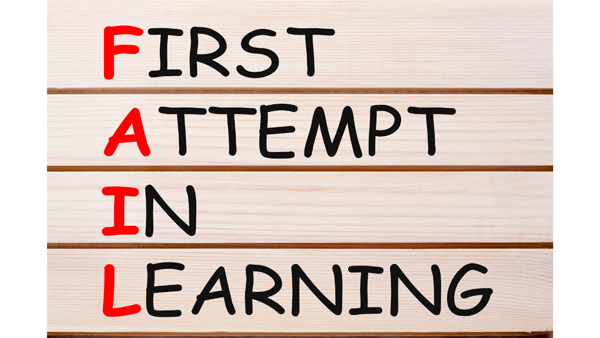
STEM projects where things can fail actually teach two things. First, we learn that failure is normal, acceptable, and often to be expected. (See our blog on Redefining Failure!) The word "fail" generally has a negative connotation, but it really shouldn't. Failure happens! Second, we learn how to analyze what has failed in order to fix the problem. This helps us better understand the thing that failed, thus giving us valuable experience we can use in similar situations in the future. In fact, I believe we learn more from failures than from successes!
Here's a short personal anecdote. I took a class in college that was the typical "memorize everything from the readings and the lectures" course. I studied for weeks for the first test, and I was confident I knew EVERYTHING! As I took the test, though, I came to a question I knew I didn't know. (That's how well I knew the material! I knew with 100% certainty that I did not know the answer to that question.) After the test, I went back through my notes to figure out why I didn't know the answer to that question. I finally found it. I had scribbled that information in tiny print in the margin of a page of notes, and when I studied, I didn't see it. That was the only question I missed on that test, and today (over 35 years later!) that is the ONLY specific fact I can remember from that class. In other words, no matter how many questions I answered correctly, the only answer I have retained is the one that I missed.
Career Opportunities
When one thinks of the career paths open to one with a STEM background, one generally thinks of the computer programmer or engineer. Each of these areas, though, is really many fields. For example, a computer programmer might work in software testing, game development, or cybersecurity. Engineering includes specialties such as aeronautical, biomedical, chemical, civil, industrial, and mechanical.
However, as I've pointed out above, even non-technical fields like financial planners, social scientists, and insurance actuaries also have need to apply skills that are developed through STEM education. A 2017 report from the United States Department of Commerce found that those with a STEM degree earn as much as 12% more than those with non-STEM degrees even when they work in the same job! Further, those that work in STEM fields may earn 29% more than those in non-STEM fields.
See, it's true. One really can do anything with a background in STEM! The skills one develops by engaging in authentic, interdisciplinary, project-based learning will transfer to nearly any career field and make one more confident and more capable when dealing with everyday life.