Put Away the Worksheet: 25 Hands-On History Activities You Can Do at Home - Part 2
By Historical Conquest LLC · October 28, 2026
History Was Never Meant to Be Boring
I have a confession that surprises people when they learn what I do for a living: I graduated from high school hating history. Yes, the person who eventually created Historical Conquest, an educational card game designed to make history exciting, once considered history one of the least interesting subjects in school. It wasn't because history lacked fascinating stories. It was because so much of what I experienced involved reading textbooks, memorizing names and dates, completing worksheets, and preparing for tests. I learned enough to get through the assignments, but much of that information disappeared shortly afterward.
Looking back, I realize that I didn't necessarily hate history. I hated the way I was learning it. I loved games, competition, strategy, creativity, and figuring things out for myself. But those interests rarely found their way into my history lessons. What if someone had asked me to plan a Roman invasion, build a medieval castle, negotiate a peace treaty, or develop a game based on historical figures? Would I have approached history differently? I believe I would have.
That is why I encourage parents to occasionally put away the worksheet and give their children something they can build, investigate, debate, experience, or create. The objective isn't to eliminate reading or memorization. It is to give children experiences that make what they read meaningful enough to remember.
From Part #1
5. Create a Historical Newspaper
Recommended Ages: 9–18
Have students become journalists covering an important historical event. They might report on the signing of the Declaration of Independence, the eruption of Mount Vesuvius, or the completion of the transcontinental railroad. Include headlines, interviews based on documented viewpoints, illustrations, and advertisements appropriate to the period.
What Students Learn: Writing, research, historical perspective, and distinguishing facts from interpretations.
6. Design an Ancient Civilization
Recommended Ages: 8–16
Give students a blank map showing rivers, mountains, deserts, and coastlines. Challenge them to establish a fictional ancient civilization. Where will they build cities? How will they obtain food? What resources can they trade? What geographical problems must they overcome?
What Students Learn: Geography, government, economics, resource management, and the development of civilizations.
7. Recreate an Archaeological Dig
Recommended Ages: 6–14
Bury replica artifacts, pottery fragments, coins, or small objects in a container of sand. Provide brushes and simple recording sheets. Students must uncover, document, and interpret each object before learning what it represents. Explain that real archaeology involves careful recording and context, not simply finding treasures.
What Students Learn: Archaeology, observation, evidence, and historical investigation.
8. Play a Historical Strategy Game
Recommended Ages: 8–18
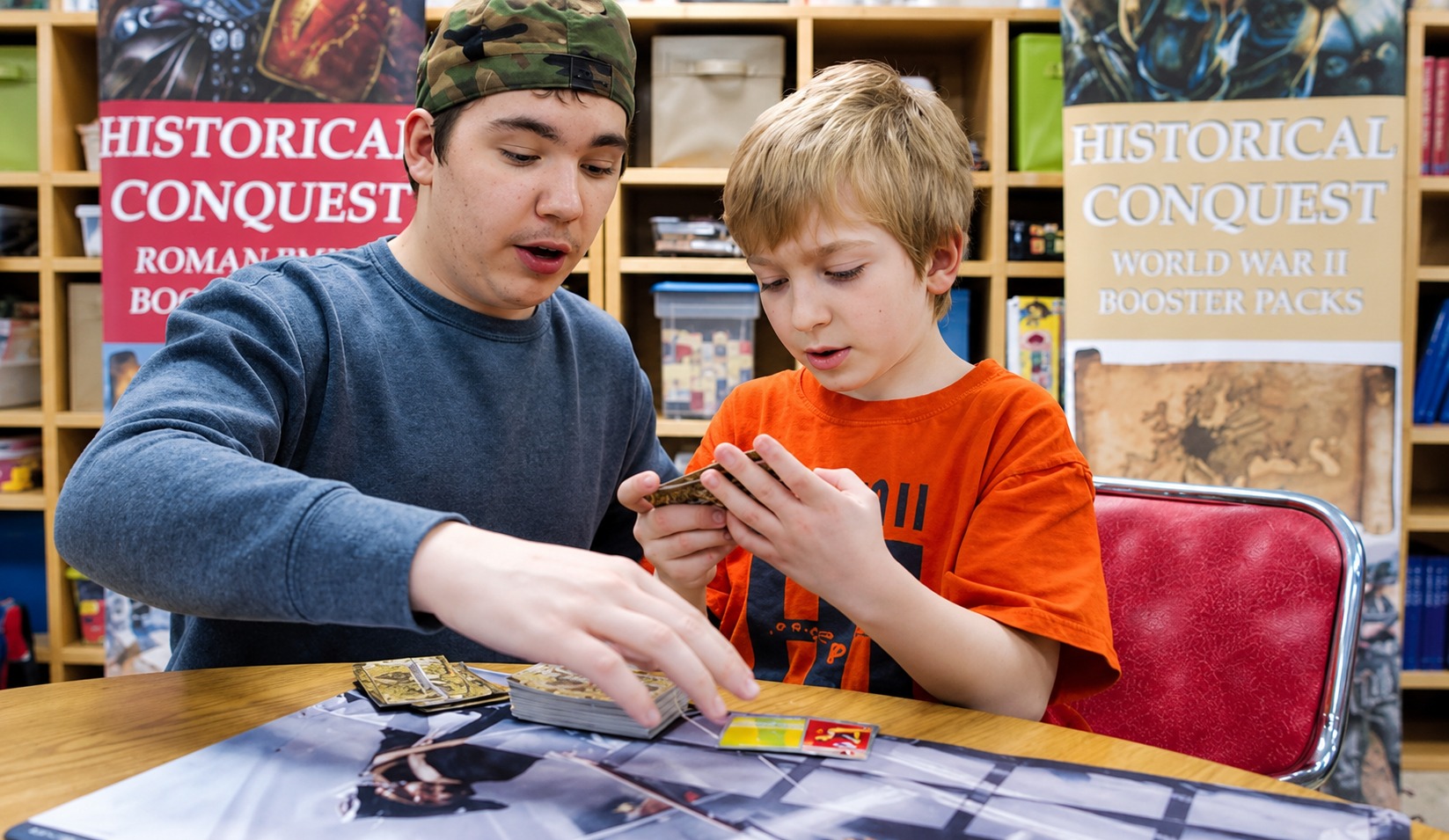
Choose a tabletop game based on historical events, civilizations, or figures. Before playing, introduce the historical setting. During the game, encourage students to explain their decisions and recognize historical references. Afterward, discuss where the game's mechanics accurately represent history and where they simplify it.
What Students Learn: Strategy, decision-making, historical recognition, and critical evaluation.
9. Build a Model of an Ancient Invention
Recommended Ages: 8–18
Construct a working model of a Roman aqueduct, waterwheel, simple pulley, ancient irrigation system, or other historical technology. Test it, identify problems, and improve the design.
What Students Learn: Engineering, physics, invention, and the relationship between historical needs and technological solutions.
10. Plan a Journey Along the Silk Roads
Recommended Ages: 9–18
Give students a map and a fictional merchant's inventory. They must plan a route, calculate distances, identify trading centers, consider terrain, and decide what goods to exchange. Discuss the movement of religions, technologies, diseases, and ideas alongside trade goods.
What Students Learn: World geography, economics, cultural exchange, and transportation.
11. Write Letters from the Past
Recommended Ages: 8–18
Have students research a historical event and write a fictional letter from the perspective of someone living through it. They might be a colonial merchant, a Roman soldier, an immigrant arriving in America, or a child during the Great Depression. Ask them to separate documented facts from imagined personal details.
What Students Learn: Historical empathy, writing, research, and understanding everyday life.
12. Create a Family History Museum
Recommended Ages: 6–18
Gather family photographs, heirlooms, letters, recipes, or oral histories. Have children create museum labels explaining each object's significance. Older students can interview relatives and investigate how major historical events influenced their family's experiences.
What Students Learn: Primary sources, genealogy, historical preservation, and connections between personal and national history.
13. Stage a Historical Debate
Recommended Ages: 11–18
Select a question such as whether the American colonies should declare independence or whether a particular invention benefited society overall. Assign opposing positions and require evidence. After the debate, have students explain the strongest argument made by the other side.
What Students Learn: Public speaking, respectful disagreement, reasoning, and evaluating historical arguments.
14. Build a Historical City
Recommended Ages: 7–16
Use paper, clay, cardboard, or building blocks to reconstruct an ancient Egyptian settlement, Roman town, medieval village, or colonial community. Students must identify homes, markets, places of worship, transportation routes, and public buildings.
What Students Learn: Urban development, architecture, occupations, and social organization.
15. Create a Historical Board Game
Recommended Ages: 9–18
Challenge students to invent a board game based on a historical period. They must develop rules, objectives, historical challenges, and a method of winning. Require them to explain why their chosen events and historical figures matter.
What Students Learn: Historical research, game design, mathematics, logic, and creative problem-solving.